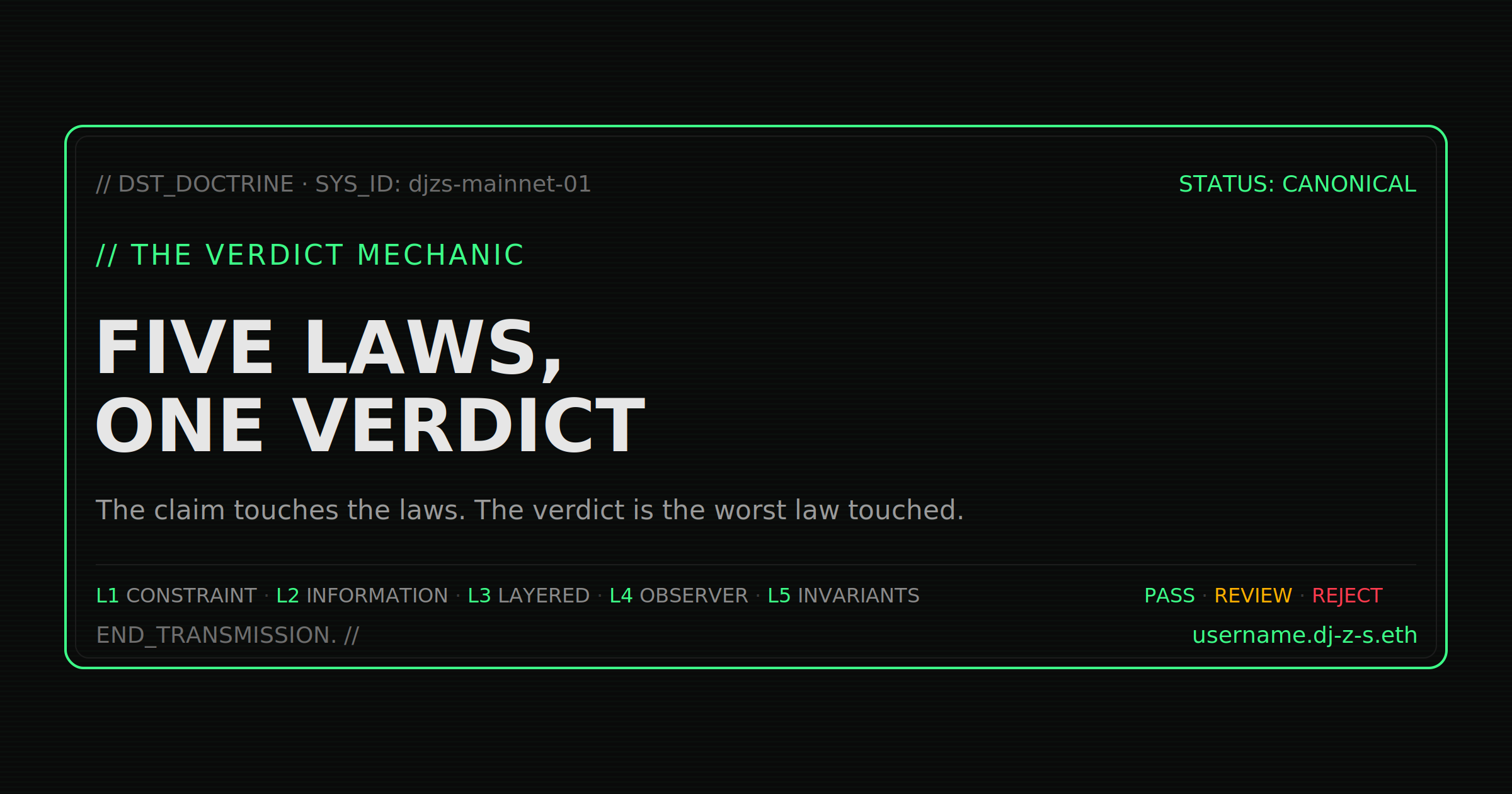
What each law catches, and how a claim about reality earns PASS, REVIEW, or REJECT.
Everyone runs a metaphysics. Free will is an illusion. We live in a simulation. Consciousness is fundamental. The past is gone. You hold versions of these claims right now, and almost none of them were ever tested, they were absorbed from a video, a thinker, a mood, and promoted straight to certainty. The Deterministic Simulation Thesis treats a claim about reality the way an auditor treats a ledger: run it against a fixed rule-set, record what survives, name exactly what breaks. The rule-set is five laws. This is the manual, what each law is, what it catches, and how five law-level results compress into a single verdict.
One thing an audit is not: a debate. There is no winning here, no team to join. A claim comes in, the laws it touches are identified, each touched law returns a result, and the verdict is rendered by a rule that never changes. The same procedure that clears a claim you hate will reject a claim you love. That is the point of a procedure.
// PROTOCOL : DST_AUDIT
// ENGINE   : L1-L5 (the Five Laws)
// VERDICTS : PASS / REVIEW / REJECT
// RULE     : verdict = worst law touched
The Five Laws
L1: Constraint Precedes Appearance. Nothing shows up from nowhere. Every appearance, a thought, a particle, a decision rides on constraints that were already in place before it arrived. L1 catches claims that smuggle in an uncaused cause: a chooser outside the causal chain, an emergence with no story underneath it, a "then something special happens" hiding in the middle of an argument. Violation signature: D01 UNCAUSED_EMERGENCE.
L2: Information Persists Across Transformation. Information is transformed, scrambled, relocated, not annihilated. L2 catches claims that quietly require clean erasure: a past that is simply "gone," a record that vanishes without residue. Physics itself fought this one out at the black hole horizon and persistence won. Violation signature: D02 ERASURE_ASSUMPTION.
L3: Description Is Layered, Not Singular. Reality supports more than one valid description at once, at different layers. Molecules are a complete description of a gas; temperature is still real. Neurons are a complete description of a decision; the choice is still real. A lower layer being lawful and complete does not make a higher layer false. L3 catches the most common move in all of popular metaphysics: it is only X, therefore Y is fake. Violation signature: D03 LAYER_COLLAPSE.
Layered is not false.
L4: Uncertainty Defaults to Observer-Local. Most of what gets called randomness is ignorance wearing a costume. The coin flip is deterministic mechanics; the uncertainty is in your position, not the coin. L4's default: treat uncertainty as located in the observer until a claim earns the stronger conclusion. It catches arguments that promote "random" to a metaphysical primitive because the arguer ran out of resolution. Violation signature: D04 RANDOMNESS_PRIMITIVE. This is the law that most often returns the honest middle REVIEW because how much residue survives at the bottom is genuinely contested.
L5: Only Cross-Framework Invariants Deserve Promotion to Theory. A result that appears in only one framework is, until proven otherwise, an artifact of that framework. What survives translation across independent frameworks, different mathematics, different starting assumptions, same result — earns promotion. L5 catches the totalizing move: one theorem, one lens, one tradition inflated into a complete account of reality. Violation signature: D05 SINGLE_FRAMING.
The gate before the laws
Before any law runs, one check decides whether the audit can happen at all: can this claim be wrong? A claim built so that every possible observation confirms it the world looks designed, and looking undesigned is just part of the design, has removed itself from testing. It is not deep. It is unfinished. The audit records S02 MISSING_FALSIFIABILITY and returns REJECT before L1 is even consulted.
A claim that cannot be wrong is not profound. It is exempt, and exemption is the verdict.
From laws to verdict
The mechanic is four steps, and it never varies.
- Identify the laws touched. Not every claim touches all five. A claim about memory touches L2. A claim about free will touches L1, L3, L4.
- Run the gate. Falsifiable? If not: REJECT,
S02, done. - Each touched law returns a result. PASS if the claim survives the law. REJECT if it violates it. REVIEW if the question is genuinely undetermined at that layer.
- The verdict is the worst law touched. A claim can be brilliantly right on one law and broken on another and the break is what stands. A chain is its weakest link, and a claim that is half-true at reality's expense is not half-cleared.
Here is the mechanic on a real audit the first one published on this site.
CLAIM   : "Free will is an illusion. The brain decides before you do."
LAWS    : L1, L3, L4
GATE    : falsifiable yes. an unconstrained decision would break it
L1      : PASS    · the decision is fully constrained; no uncaused chooser
L3      : REJECT  · D03 LAYER_COLLAPSE  a lawful substrate does not
                    make the choice-layer fake
L4      : REVIEW  · D04  how much residue is observer-ignorance
                    remains contested
VERDICT : REJECT  · the worst law touched
The determinism half of the claim is correct L1 clears it without hesitation. The "illusion" half commits the oldest layer collapse there is, and the collapse is what the verdict records. Right about the machinery, wrong about what the machinery means: REJECT, with the credit and the break both on the record.
What the three verdicts mean
PASS is a finding, not praise. It means the claim survived every law it touched and the audit still names the open edge, the part that remains undetermined, because honesty about the residue is the entire credibility of the lens.
REJECT is a correction, not a takedown. It names the law broken, the code that broke it, and explains the category error in plain language. It credits what held. A claim can PASS L1 and REJECT L3 in the same audit, and the record shows both.
REVIEW is the honest middle. Some questions do not resolve at the current resolution, and a lens that never says so is not looking it is posing.
Fourteen thinkers have been through this procedure so far: ten cleared, four rejected. Carroll and Rovelli entered from opposite interpretations of quantum mechanics and both passed, because the audit tests law-survival, not team membership. And the best-known simulation argument there is Bostrom's trilemma was rejected on L5, by a simulation thesis, because its probabilities live only inside their own framing. A lens that could not reject its own neighborhood would be a mirror. This one did.
The observer turn
Every DST audit ends the same way, and so does this manual: the subject was never really the philosopher. It is you. You are running un-audited claims about reality right now, about your choices, your memory, your uncertainty, what is fundamental and what is fake. So run the procedure once, honestly, on the certainty you would least like to test. Which laws does it touch? Would it survive them or has it simply never been asked? Notice which layer you are standing on when you call another layer an illusion. That noticing is the entire practice.
{
  "document": "five-laws-verdict-mechanic",
  "class": "DST_DOCTRINE",
  "laws": ["L1", "L2", "L3", "L4", "L5"],
  "verdict_set": ["PASS", "REVIEW", "REJECT"],
  "aggregation": "worst_law_touched",
  "master_gate": "S02_MISSING_FALSIFIABILITY",
  "record": "14 audited: 10 PASS, 4 REJECT",
  "logic_hash": "djzs:dst:0705:laws:001"
}
If you want this same rigor pointed at your capital instead of your worldview, the Operator audits at djzs.ai.
END_TRANSMISSION. //